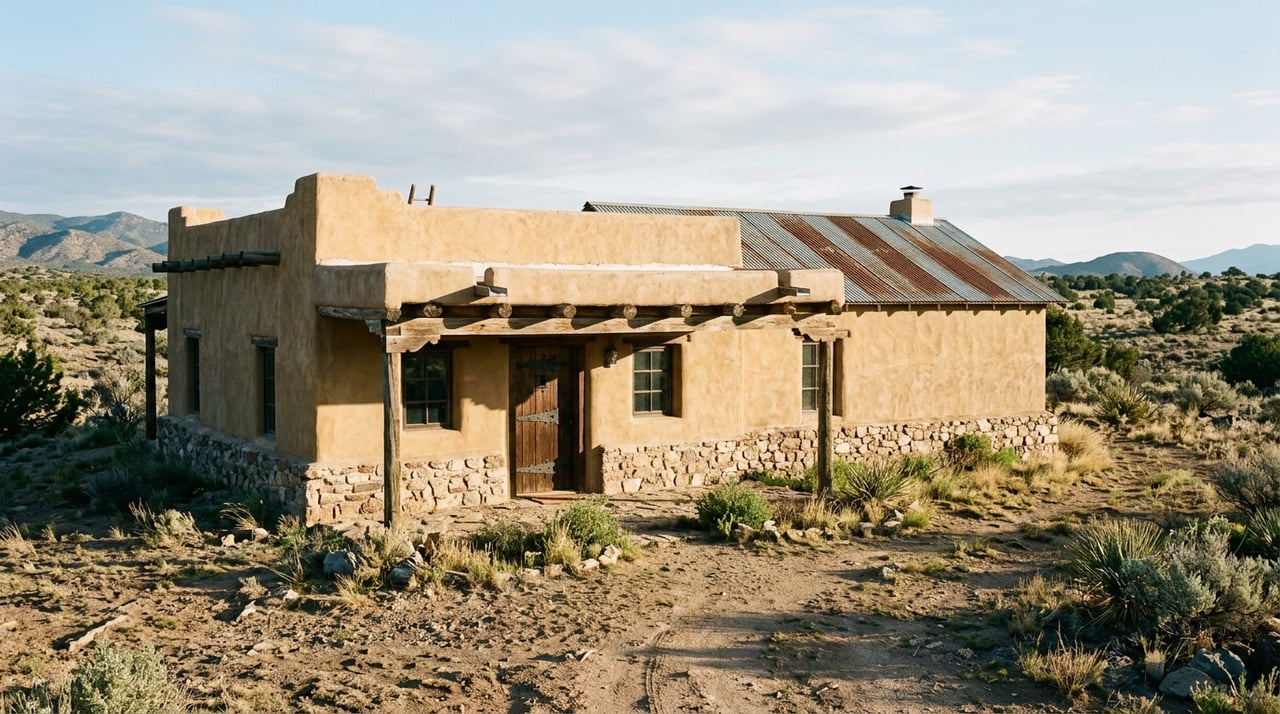
If you drive NM-14 through Tijeras often enough, you know the building. It sits back from the road near Cirquela Road, thick-walled and quiet, the kind of structure that makes you slow down without quite knowing why. Most people who pass it assume it has been empty for decades, a ruin waiting for someone to either fix it or tear it down. That assumption is wrong, and the real story is more interesting than the ruin everyone imagines.
The Campo Stone House was never abandoned. It was lived in, worked in, and passed down inside one family for more than a hundred years. It only became public property in 2023. Understanding why it took that long, and why the plan to finally open it to the public won't be finished until at least 2028, tells you something true about how things actually get built in the East Mountains.
What Carlos Campo Built
The land itself goes back to 1819, part of the Cañón de Carnué Land Grant. The Juan Zamora family were among the first to receive a parcel, and in 1887 their descendants sold a piece of it to an Italian immigrant named Carlos Campo. By the late 1880s, Campo had built a store, a saloon, and a dance hall on the property, along with an orchard and a vineyard. For decades, that cluster of buildings functioned as the actual center of community life in what is now Tijeras. People bought supplies at the store, drank at the saloon, and danced at the hall on weekends.
The building still standing today includes original vigas, the heavy log rafters that supported the roof of that era. It is one of the only physical pieces left of that original settlement.
The Crash That Ended the Dance Hall
Carlos and Dena Campo died in 1930, and the property passed to newlyweds Flaviano Sanchez and Dulcinea Armenta, who converted it into a home while keeping the dance hall open for community events. Fifteen years later, a car left the highway and destroyed the dance hall entirely. What survived was the stone house itself, the store and saloon structure, which continued as a private residence for the next several generations.
That detail matters because it explains why the building never looked like a landmark waiting to be saved. It looked like someone's house, because it was.
The Building Was Never Empty Until It Was
The stone house stayed in private hands until 2023, when Carlos Campo's great-grandson, Chuck Jackson, bought the property and then donated it to the East Mountain Historical Society. That donation is the real turning point in this story, more than any grant application or fundraising number. A building that had been continuously occupied by one family's descendants for over a century suddenly became a nonprofit's responsibility, with all the slower machinery that comes with it.
Here is the timeline as it actually happened, not as a highlight reel:
| Year | What Happened |
|---|---|
| 1819 | Cañón de Carnué Land Grant settled |
| 1887 | Zamora descendants sell parcel to Carlos Campo |
| Late 1880s | Campo builds store, saloon, and dance hall |
| 1930 | Property sold to Flaviano Sanchez and Dulcinea Armenta after Campo family deaths |
| ~1945 | Car crash destroys the dance hall |
| 2023 | Chuck Jackson donates the stone house to the East Mountain Historical Society |
| 2026 | Society announces $2.9 million restoration goal |
| 2028 | Target groundbreaking, if funding comes together |
Five years between the donation and a hoped-for groundbreaking is not slow by accident. It reflects how preservation actually works once a private building becomes a public one: a master plan first, then grants, donations, and state and federal funding pursued in parallel, none of it guaranteed on any particular schedule.
Why the Historical Society Doesn't Have a Home Either
There is a detail in this story that locals tend to miss: the organization trying to save the region's history has never had a permanent building of its own. Committee co-chair Andre Larroque put it plainly when describing where the group has operated from over the years, saying they've met at the library, Tijeras Village Hall, and various other places, mostly in Tijeras. The archives the society is trying to protect are currently stored at the Tijeras Senior Center, a workable arrangement but not an archive built for the job.
That is the actual stakes of this project. It is not just a stone building getting a facelift. It is the region's own historical record sitting in a borrowed room while a nonprofit tries to raise the money to give both the building and the archive a real home.
What Two Kickstarters Have in Common
A few miles up the road in Cedar Crest, a smaller version of the same pattern already played out. In early 2025, Rumor Brewing Co., the brewery and family restaurant tucked behind the Cedar Crest post office, ran a Kickstarter campaign to fund a play area in its beer garden, aiming for $10,000. Owner Patrick Johnson described the shift plainly, saying the business opened as a brewery but has become more of a restaurant that also makes beer, driven partly by the fact that he and his brewer both have young kids growing up around the place.
It is a different scale of project entirely, but the mechanism is the same one running the Campo Stone House restoration. Nobody is writing a single check to make either of these things happen. Both depend on grants, community pledges, and patience measured in years rather than quarters. If you want to understand how institutions actually get built in the East Mountains, whether that's a 140-year-old landmark or a neighborhood beer garden, this is the pattern to watch for.
What to Actually Expect
If you are hoping to walk through the Campo Stone House as a finished visitor center next summer, you will be waiting a while longer. The society is still in the grant and donation phase, with 2028 as the earliest realistic groundbreaking. That is not a criticism of the effort. It is simply how preservation funding works when the money has to come from a combination of grants, donations, and state and federal sources rather than a single developer's budget.
What is worth doing in the meantime is paying attention. The East Mountain Historical Society holds its meetings in borrowed rooms around Tijeras, and those meetings are where you will hear the real updates on funding progress long before anything shows up on the building itself. If the stone house on NM-14 has ever made you slow down while driving past it, now you know exactly what you are looking at, and what it is going to take to see it finished.
If you're thinking about property in the East Mountains, Tijeras, or anywhere else along the Turquoise Trail corridor, and you want someone who actually knows the terrain, the access questions, and the history behind it, Michael Sanford is worth a conversation. Let's Connect.