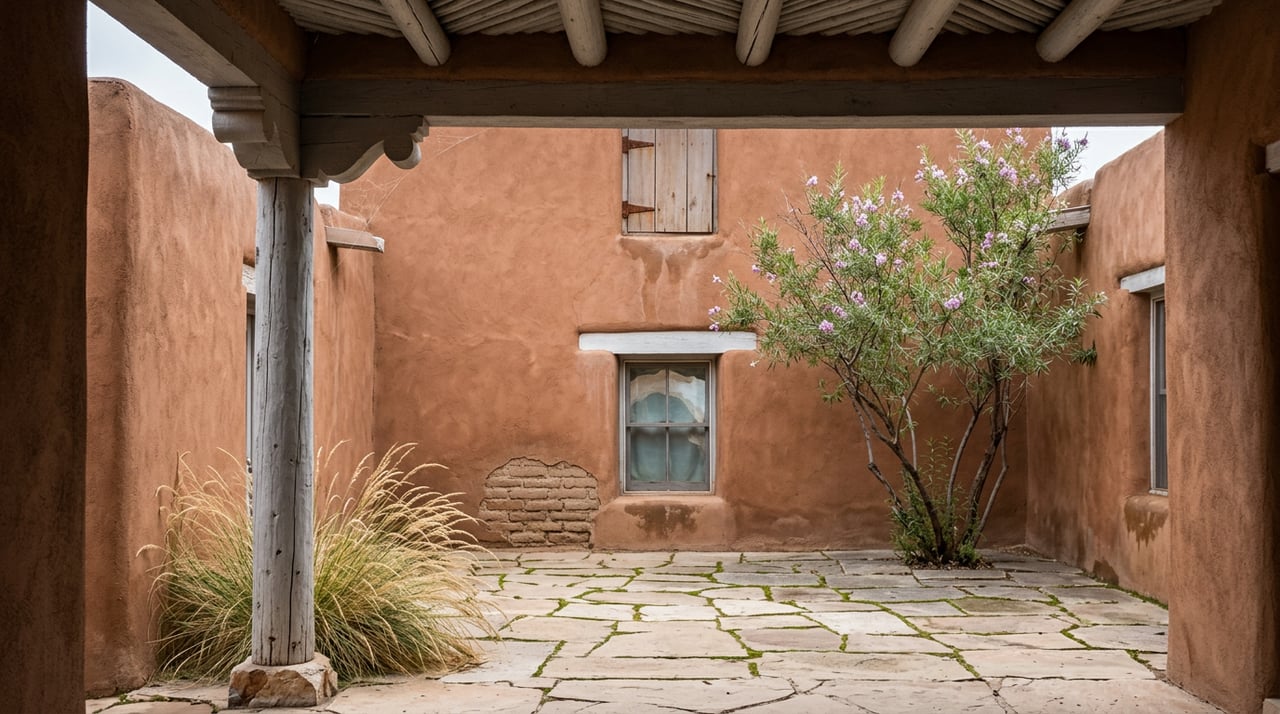
If you live within walking distance of the Plaza, you already know the portal at the Palace of the Governors as a fixture, not an event. Rain or shine, artisans from New Mexico's pueblos and tribes lay out silver and turquoise on blankets under that long adobe overhang, and a daily lottery decides who gets a spot. It has worked this way for decades. So here is the detail that surprises even longtime residents: on the two days when downtown fills with more people looking for authentic Native art than at any other point in the year, the portal itself sits empty.
This weekend, on August 15 and 16, the Santa Fe Indian Market takes over downtown for its 104th year, and the year-round program that gives the Palace its identity moves indoors.
A Program That Never Actually Closes
The Native American Artisans Portal Program is easy to take for granted precisely because it runs every day. Participants sell their work under the portal of the Palace of the Governors on the Plaza, a practice the New Mexico History Museum has sponsored since the arrangement took its modern shape. It traces back to 1936, when Maria Chabot, working with the New Mexico Association for Indian Affairs, organized weekend markets under that same portal.
For decades afterward, the space stayed informal enough that the Museum of New Mexico's Board of Regents felt it needed to intervene. In 1972, the board established a policy reserving the portal for sales by Native American artists only. That policy still governs who can set out a blanket there. Today, more than 1,500 artisans are authorized to participate, and a daily lottery decides which of them get a place under the portal on any given morning.
This is the part locals walk past without registering: the portal program is a lottery-run, tribally-restricted marketplace operating 365 days a year, not a backdrop for tourists. Vendors must be enrolled members of one of 23 federally recognized tribes, pueblos, or nations located within New Mexico, with narrow exceptions for spouses of enrolled members and graduates of the Institute of American Indian Arts.
Where It Goes for Two Days
Indian Market weekend does not add to that daily market. It displaces it. For both days of the market, the Portal Artisans Program relocates from its usual spot under the Palace facade into the museum's courtyard, running from 10 a.m. to 4 p.m. This is not new this year. The same relocation happened during the 2025 market weekend, and the pattern has held for as long as the two events have coexisted on the same footprint of Plaza real estate.
The contrast is worth sitting with. The Indian Market itself is a juried event, with SWAIA vetting nearly 1,000 artists from more than 200 tribal nations before they're allowed to set up a booth on the street. The portal program runs on its own separate jury, its own lottery, its own 23-tribe eligibility rule, and its own courtyard on market weekend. Two authentication systems, operating a few hundred feet apart, on the same two days.
If you have a regular portal vendor you know by name, this is the weekend they will not be where you expect them.
What Actually Closes, and What Was Already Closed
Residents who dread Indian Market traffic are often bracing for something that is already baked into the neighborhood's summer. Lincoln Avenue has been closed to cars since 2020. Palace Avenue is closed permanently. Old Santa Fe Trail is closed to vehicles for the summer months already. None of that is new for market weekend. It is the status quo the rest of the season already runs on.
What changes for the market itself is scale, not novelty. Booths run down the surrounding streets, foot traffic swells into the tens of thousands, and the closures that are already routine become the only way in or out.
Here's the quick version of what's different this weekend versus a typical August Saturday downtown:
| Typical summer weekend | Indian Market weekend (Aug 15–16) | |
|---|---|---|
| Portal artisans | Under the Palace portal | Relocated to the Palace courtyard, 10 a.m.–4 p.m. |
| Lincoln Ave, Palace Ave | Already closed to cars | Same closures, heavier foot traffic |
| Old Santa Fe Trail | Closed for summer | Same closure, plus market booths |
| Public parking | Tight but findable | Sandoval Garage and the Convention Center Underground Garage fill by early morning |
| Downtown transit | Regular Santa Fe Trails routes | Free shuttle service added between key locations |
The Bigger Conversation Behind the Barricades
The reason these closures keep expanding is not really about any single event. Santa Fe City Councilors Alma Castro and Pat Feghali, who represent the downtown district, have proposed making car-free Plaza streets permanent through the summer, arguing that the current pattern of frequent closures for events like Indian Market, Fiesta de Santa Fe, Pride on the Plaza, and free summer concerts has already made the area function that way in practice. City staff have told councilors the Plaza sees an estimated 1.5 to 2 million pedestrians a year, and, as the Santa Fe New Mexican reported, Feghali put the safety case plainly: "I have heard from plenty of city staff that street is unsafe in the summer months."
The resolution under discussion would designate Palace Avenue as a loading and unloading zone for vendors and ban car traffic, pedicabs, and walking and bike tours from the street, with an exception carved out for cruise nights. It would also give the city room to extend the closure into part of November, when the Plaza has hosted Día de los Muertos and Indigenous Peoples Day events in recent years.
Whether or not the resolution passes, the direction is clear. Indian Market weekend is not an anomaly the neighborhood tolerates once a year. It is the loudest version of a pattern the Plaza already runs on for most of the summer.
Getting to Your Own Front Yard
For residents who live inside the pedestrian core, the honest answer is often to just walk. For anyone coming from farther out in the neighborhood or the wider city, a few specifics make the weekend easier.
In recent years, Santa Fe Trails Transit has partnered with the market to run free bus and shuttle service between key locations around town for both days of the weekend, a partnership aimed squarely at getting people out of their cars. The New Mexico Rail Runner Express is the other reliable option: ride it to the Santa Fe Depot, and it's a short, scenic walk from there into the market itself.
If you do need to drive, the Sandoval Garage and the Convention Center Underground Garage are the two public options within walking distance of the Plaza, and both tend to fill before the market opens for the day. Anyone hoping to catch the Native Fashion Show, one of the most popular ticketed events of the weekend, should know it routinely sells out weeks or even months ahead. Behind the scenes, the market's own internal schedule runs earlier than most residents realize: artist receiving happens the Wednesday before market at the Convention Center, judging is closed to the public on Thursday, and Best of Show is decided Friday morning, before a single booth opens to visitors.
The Rest of the Summer Calendar
Indian Market sits inside a longer stretch of Plaza-centered events that shape how this neighborhood runs from July through September. This summer already brought Pancakes on the Plaza on July 4, a nearly 50-year tradition of breakfast, vintage cars, and live music on the square, and the Traditional Spanish Market and Contemporary Hispanic Market brought their own round of street closures in late July. Next on the calendar after Indian Market is Zozobra: on September 4, Fort Marcy Park hosts the 102nd burning, this year built around a theme honoring America's 250th anniversary.
None of these events are interchangeable, but they add up to the same underlying fact: living two or three blocks from the Plaza means living next to a stage that gets used more often than it used to, by a wider range of communities, for longer stretches of the summer. Indian Market is simply the version of that pattern with the most people, the tightest logistics, and the clearest example of what gets asked to move when the crowd shows up.
The portal artisans return to their usual spot under the Palace the moment the market packs up. The conversation about whether these streets stay car-free longer than two days a year is not likely to resolve as quickly.
Mike Sanford has spent his career working in and around the neighborhoods that make up Santa Fe's rural and historic edges, and he pays attention to how these places actually function day to day, not just how they show up in a listing. If you're curious what a specific block near the Plaza, or a property farther out toward Galisteo, Cerrillos, or the East Mountains, might mean for your own plans, Michael Sanford is glad to talk it through. Let's Connect.


