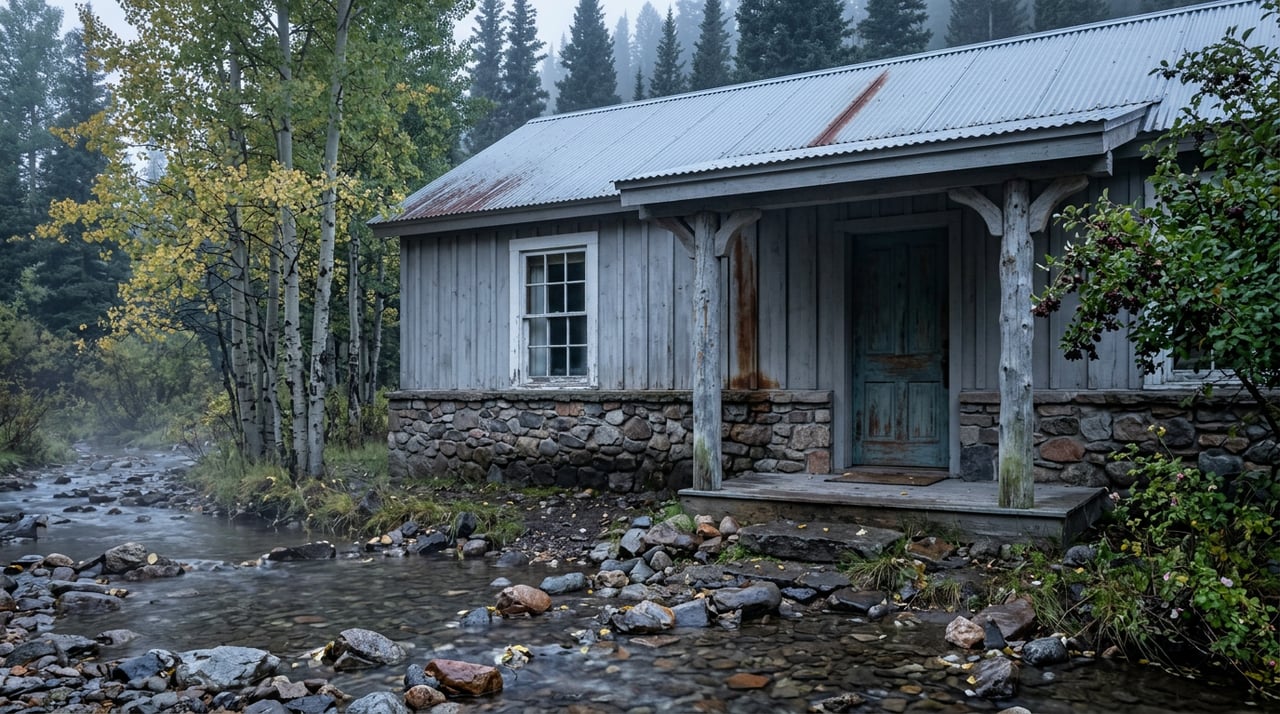
Ask someone new to Mora County where to spend a Saturday on the water, and they'll usually collapse two very different places into one vague answer: "there's the lake by Mora, and there's Coyote Creek." Both are state parks. Both sit in the eastern foothills of the Sangre de Cristo Mountains. Both get stocked with trout every year. It sounds like picking between two versions of the same afternoon.
It isn't. Coyote Creek State Park and Morphy Lake State Park sit about 24 miles apart by road, and they operate on nearly opposite rules. One has electric hookups, a dump station, showers, and stays open every day of the year. The other bans gas motors on the water, caps RVs at 18 feet, and shuts its campground down for roughly five months when the mountain turns cold. The distance on the map doesn't tell you much. The rules do.
The Park Built to Keep You There
Coyote Creek sits 17 miles north of Mora off NM-434, in a 462-acre stretch of Guadalupita Canyon where the creek runs almost due south through spruce and pine. It's the kind of park designed for a full weekend rather than a quick stop: 47 developed campsites, 17 of them with electric hookups, plus showers, a playground, a group picnic shelter, a visitor center, and a centrally located RV dump station. A two-mile nature trail loops through the park and crosses the creek twice.
The creek itself carries the park's real reputation. Multiple sources, including Wikipedia's entry on the park, describe Coyote Creek as the most densely stocked trout stream in New Mexico. That density is why anglers keep coming back, and why the park's own superintendent, Donovan Velasquez, who oversees both Coyote Creek and Morphy Lake, put it plainly to KRQE:
"Once people find [Coyote Creek], they return. They're hooked."
Day use runs $5 per vehicle, with pedestrians and cyclists getting in free, and the park lists itself as open around the clock, every day of the year, with occasional weather-related closures. At roughly 7,700 feet, it sits low enough that winter doesn't lock the gate the way it does 24 miles south.
The Park That Makes You Earn It
Morphy Lake asks something different of you before you've even parked. The park sits 7 miles southwest of Mora and 3 miles northwest of Ledoux, reached off NM-94 by a 3-mile gravel road that can require four-wheel drive in bad weather. Low-clearance vehicles and trailers are discouraged for a reason: the roads inside the park are narrow dirt lanes, tight enough that RVs and trailers over 18 feet aren't allowed, and tight enough that the park had to build four loop roads just so vehicles have somewhere to turn around, since backing out isn't realistic on most of the interior roads.
Once you're in, the amenities thin out fast. There's no electric or water hookups, no dump station, and camping runs first come, first served on primitive sites that circle the lake's northern and eastern shoreline. Vault toilets are the only fixed infrastructure. Bring your own water.
The lake itself is small by design: 15 to 25 acres, holding around 400 acre-feet, formed when an earthen dam built in the late 1930s enlarged a natural basin. New Mexico's state parks division stocks it with rainbow trout and kokanee salmon, and state wildlife stocking records show a July 2025 release of 1,351 catchable-size rainbow trout along with 150 larger fish. Boats are allowed, but only if they're non-motorized or running electric motors. Gas engines aren't permitted on the water at all.
Elevation is the other lever here. Morphy Lake sits close to 8,000 feet, several hundred feet higher than Coyote Creek, and that altitude is exactly why the park closes for the season. Because of its remote location and harsh winters, the park shuts down from November 1 through April 1 each year, reopening once the access road is passable again.
Same County, Two Different Contracts
Laid side by side, the contrast is less about scenery and more about what each park is willing to give you in exchange for what it asks.
| Coyote Creek State Park | Morphy Lake State Park | |
|---|---|---|
| Distance from Mora | 17 miles north on NM-434 | 7 miles southwest, off NM-94 |
| Elevation | About 7,700 feet | About 8,000 feet |
| Camping season | Year-round, weather permitting | April through October, closed Nov. 1–April 1 |
| RV limit | Standard sites, 17 with electric hookups | 18 feet maximum, no hookups |
| Boat motors | Not the park's focus, creek fishing only | Non-motorized or electric only, no gas |
| Access road | Paved highway | 3-mile gravel road, narrow interior lanes |
| Day-use fee | $5 per vehicle | Not separately listed |
Neither park is objectively better. They're built for different tolerances. Coyote Creek is engineered to remove friction: paved access, hookups, a dump station, a playground for the kids, a creek famous enough that Velasquez says people get hooked after one visit. Morphy Lake removes almost none of the friction on purpose. The gravel road, the RV cap, the missing hookups, and the five-month closure all function as a quiet filter. The people who make the drive already know what they're getting, and the ones who don't tend to turn around at the gravel.
Why the Friction Is the Point
That filtering effect is worth sitting with, because it isn't unique to these two parks. It's a smaller version of something that shows up across Mora County generally: the gap between a place that looks reachable on a map and a place that's actually easy to get to in October. A 3-mile gravel road that needs four-wheel drive after rain, a seasonal closure tied to elevation, an RV limit set by how tight the turns are: these are the same kinds of details that separate a scenic parcel from a livable one anywhere in this county's rougher terrain.
Locals already sort themselves by these details without thinking too hard about it. New arrivals tend to treat "the lake near Mora" and "Coyote Creek" as interchangeable until the first time they try to bring a 22-foot trailer up Morphy Lake Road, or the first November they show up expecting a campsite and find the gate closed until spring. After that, the distinction sticks.
Twenty-four miles isn't a long drive out here. But it's long enough, apparently, to separate a park that wants to keep you all weekend from one that closes for five months of the year.
If you're weighing land or a home base somewhere between these two parks, whether that means understanding what a gravel easement actually means for winter access, or figuring out which parcels sit low enough to stay reachable year-round, that kind of terrain reading is exactly where local, hands-on experience matters most. Michael Sanford has spent decades walking rural New Mexico properties before making a call on them. Let's Connect if you want a second set of eyes on a piece of Mora County ground before you commit to it.


