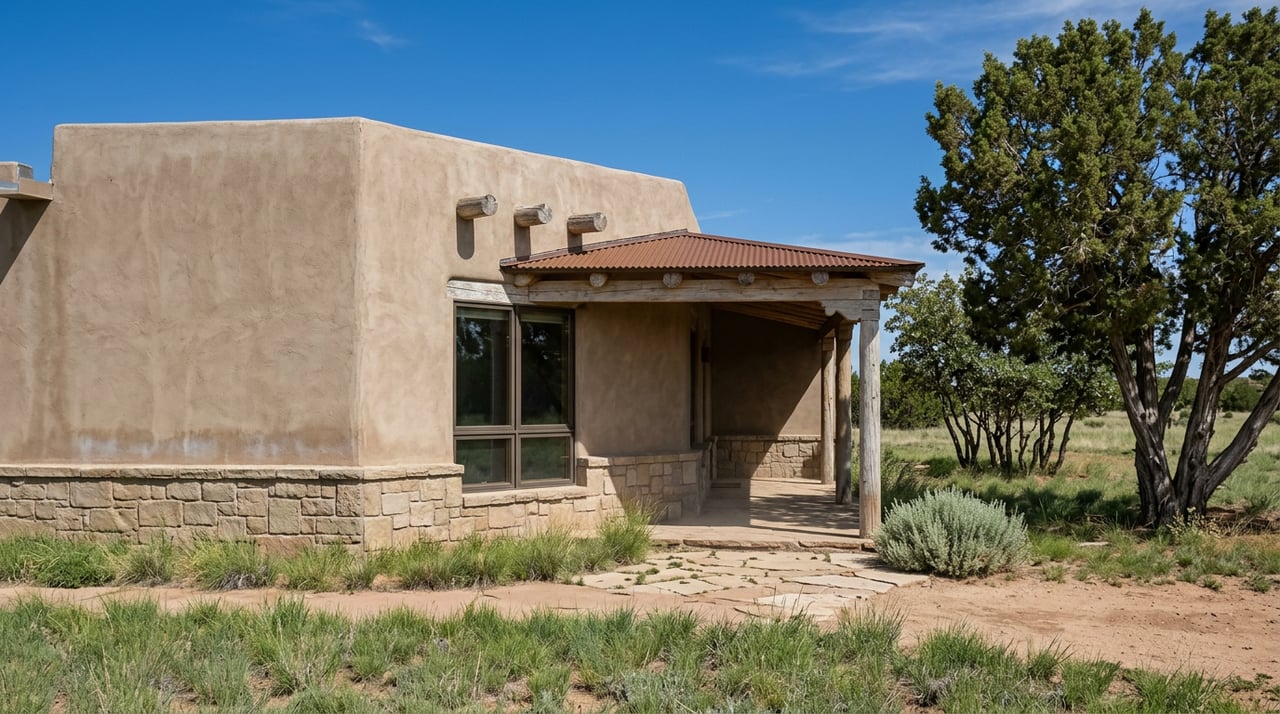
A Santa Fe New Mexican report describes the white church at San Miguel del Bado looking out over what used to be the village plaza, now mostly open field bordered by adobe ruins and a historic marker that went up not long ago. Few people live in the village proper. The Pecos River still runs past it on its way south along NM 3, the same crossing point that gave the place its name, a bado being the old word for a river ford. It is easy to drive through this stretch of San Miguel County and read it as a historical footnote, a pretty ruin with a good story attached. It is not. There is an active board of trustees meeting to plan how to buy some of this land back, and it also has plans to restore a historic adobe structure near the old plaza.
Here is the claim worth sitting with before you write an offer: the board's stated interest in acquiring unused land is part of the local context worth understanding before you make an offer.
What 1897 actually took, and what it left alone
The San Miguel del Bado Land Grant traces back to 1794, when 52 families petitioned Governor Fernando Chacón for land along the Pecos, and to a second allocation in 1803 that brought the total to 58 heads of household. Each family received a house lot, a solar, and a strip of farmland along the river, a suerte. The rest, the pasture, timber, and grazing ground that supported the whole community, was held as ejido, common land shared by everyone on the grant. By the time surveyors finished their work in the 1890s, the grant covered more than 300,000 acres.
Then came United States v. Sandoval in 1897. The Supreme Court ruled that the ejido had never actually belonged to the community in a way the courts would recognize. It had been held in trust by the Spanish and Mexican governments, not owned outright, and that distinction meant it reverted to the federal public domain. The private allotments, the solares and suertes families had lived on and farmed for a century, were confirmed and stayed in private hands. Everything else—roughly 310,000 of the 315,300 acres—was gone. The confirmed private allotments totaled just over 5,000 acres.
San Miguel del Bado was not alone. Six other New Mexico land grants lost their commons the same way, a group now referred to as the Sandoval Seven, and several of them are working together today on the same kind of recovery effort.
The board's land-purchase effort
More than a century later, the San Miguel del Bado Land Grant Board of Trustees, recognized as a political subdivision of the state, has received $150,000 in state capital outlay to pursue a land buyback. Board secretary Louis Gallegos, who grew up in the village and still lives near Villanueva, has described the goal plainly: recover pieces of what was lost. The board is negotiating with federal agencies and, according to reporting in the Santa Fe New Mexican, is specifically eyeing land that is privately owned but sitting unused.
Separately, the board is working with the Bureau of Land Management under the Recreation and Public Purposes Act to acquire a 68-acre parcel that contains two cemeteries. That is one example of the board's current acquisition work. It is buying land through federal channels, one negotiated purchase at a time, aimed at parcels that already look idle.
The board's ambitions extend past acreage. It has also received roughly $300,000 in state capital outlay to restore a collapsed adobe structure near the old plaza, dating to the 1820s, into a museum. Gallegos has pointed to El Rancho de las Golondrinas in La Cienega as the model he has in mind, a working history museum that could draw visitors to communities along NM 3. Restoration work is expected to start once the board finalizes a contractor, following its work with a Santa Fe architecture firm on the design.
It is a civic institution with state funding, a board of named residents, and a specific list of acquisition targets. Those details offer context for understanding the board's current work.
What the ejido split still means at ground level
| Before 1897 | After 1897 | |
|---|---|---|
| Private allotments (solares, suertes) | Confirmed to individual families | Remained confirmed private title |
| Common land (ejido) | Shared grazing, timber, water access | Reverted to federal public domain |
| Total grant acreage | Roughly 315,300 acres | About 5,024 acres in private hands |
A parcel's location relative to that split still matters today, because because it shapes what you can reasonably assume about access, water, and neighboring land use. A property that was part of an original solar or suerte was a family allotment. A property carved out of former ejido land may sit closer to land the board is actively trying to acquire.
Water doesn't run the same way twice in this county
San Miguel County spans three water basins, the Upper Pecos, the Canadian River, and the Tucumcari, and the Southwest Environmental Finance Center says acequias here are managed as local government units under state oversight rather than as a single countywide system. The community that draws from Storrie Lake through the Las Vegas Acequia Association, up near the county seat, has nothing to do with the small, independent ditches serving the Pecos River communities around San Miguel del Bado and Ribera. If a parcel you're considering includes any claim to irrigation water, the acequia governing that water is local to that specific stretch of river, not a countywide authority you can research once and apply everywhere.
What to actually check before you offer
- Confirm whether the parcel's title traces back to a solar or suerte allotment, or whether it was assembled later from land that passed through the federal public domain.
- Identify which specific acequia, if any, serves the parcel. Do not assume the arrangement at one property tells you anything about the property next door.
- Ask whether the parcel has been vacant or minimally used for an extended period. That status alone does not affect your ability to buy it, but it is useful context for understanding the board's stated interest in acquiring unused property.
- Verify access easements independently. A grant-era footprint does not guarantee a recorded right of way exists today.
San Miguel County currently carries one of the larger inventories of rural land for sale in the state, with active listings ranging from small acreage to full working ranches. That volume tells you this corridor is a live market, not a museum piece, which is exactly why the history above is worth understanding rather than skipping past.
A few questions worth asking directly
Does the land grant board's buyback effort affect my ability to get title insurance? Title companies underwrite these parcels routinely. The board's activity is a separate, ordinary purchase negotiation
The Sandoval ruling settled the private allotments over a century ago. The current buyback effort targets land the board can negotiate to purchase.
Does any of this apply if I'm buying near Pecos or Villanueva instead of San Miguel del Bado directly? The Sandoval decision affected the San Miguel del Bado grant specifically, along with six others across northern New Mexico. Parcels outside those historic grant boundaries were never part of the ejido split described here, though acequia governance still varies parcel by parcel across the county regardless of grant history.
If you're looking at acreage anywhere along the Pecos River corridor, from Ribera down through San Miguel del Bado and out toward Villanueva, the history above isn't a reason to hesitate. It's a reason to ask better questions before you make an offer. That's the kind of groundwork Michael Sanford does on every rural parcel, checking title history, water rights, and access before a client gets attached to a property that might not hold up under a closer look. Let's connect if you're evaluating land in this part of San Miguel County.
This article is general information, not legal, tax or financial advice. Consult a qualified professional about your situation.


